In contemporary neo-pagan communities the holiday activities associated with the autumnal equinox typically focus around harvest duties. Many participants complete a gathering of produce from the garden (or farmer's co-op or store) and take time to acknowledge and express gratitude to the gods and goddesses for these blessings. Some neo-pagans may manifest ritual which addresses the balance between light and dark as at this time of year, as after this day the rhythms of the sun's movement leaves little doubt that we are sliding into the dark time of the calendar. Many neo-pagans call this holiday Mabon, following the tradition of Aidan Kelly's naming of the holiday after the Welsh mythological hero Mabon ab Modron.
Autumnal equinox celebrations in antiquity can be difficult to discern today. Written records describe harvest activities and celebrated breaks from working in the fields, but often lack direct acknowledgement of religious ties connected to these practices. Furthermore, the date of these festivals varied greatly from one region to another, dependant upon local weather and types of crops. In fact, linguistic evidence suggests that there may not have been major religious observances at the autumnal equinox among most ancient Indo-European cultures; autumn is the only season that does not have a common root word amongst Indo-European language families.
In historical records of Slavic cultures the celebration of Dozynki (Polish; Dozhinky in Russian, literally "little sheaf") notes the end of the harvest period. Depending on the region this festival can fall anywhere from mid-August through mid-September. During Dozynki the last sheaves of grain are harvested from the field with the exception of the last corner, which is tied together and bent towards the ground. This practice, which still occurs today, is referred to as "curling the beard (of Weles)." Weles is a cthonic Slavic god of cattle, deep waters, and the dead as well as music and magic. It is thought that this reuniting of the grain with the earth transfers the energy from the harvest back into the earth. Oftentimes this "beard" is bedecked with ribbons and trinkets and left offerings.
Saturday, September 21, 2013

Friday, September 20, 2013
Book Review: Being a Pagan
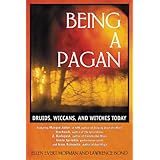 I chose to read/review Being a Pagan: Druids, Wiccans and Witches Today for my second Dedicant Path book review. One of several options listed as fulfilling the Modern Paganism and Pagan Revival category, I looked forward to this work, compiled and completed by Ellen Evert Hopman and Lawrence Bond, as something new since I had read other works in this category many years ago.
 Being a Pagan is, fundamentally, a collection of Q&A sessions completed with individuals considered "movers and shakers" within the pan-pagan community. Divided into seventeen different path-oriented chapters, the interviews each begin with a standard "Are you pagan? When did you decide you were pagan?" opening and then delve into each individual's experiences and practices as a modern pagan. This format allows each interviewee to speak freely on his/her own specialties or, as is sometimes apparent, his/her own soapboxes. Overall, the interviews are easy to follow and most chapters include an introduction that summarizes the uniting theme of interviews contained within. There does not seem to be any discernible chronology or reason for the order of the chapters so at times the reader is being referred to individuals and content found much later in the book.
In my opinion, however, Being a Pagan does not leave the reader with a positive view of modern pagans. As a result of the repetition of certain threads and themes, a mind-numbing reading of all 50 interviews paints a portrait of modern pagans as an elitist, self-legitimizing group of individuals who are constantly at odds. Indeed, several interviewees take shots at each other concerning fundamental issues, such as the roles of gender and sexuality, and whether pagan clergy should be paid for their services.
My biggest issue with the book is actually the apparent contradiction with the word "Today" in the title. Being a Pagan was first published back in 1996 - many of the issues and players highlighted in this work are virtually nonexistent in today's pagan communities. In fact, many of the organizations and resources highlighted near the end of the book no longer exist (and no website information is listed for those that do). All but one of the interviews in the 2002 re-release were completed prior to 1995; this means that nearly 20 years of contemporary pagan voices and issues are not present in this work. This critical oversight means that current topics such as leadership and gender, pagan involvement in interfaith communities and the role of the Internet in modern religion are completely absent. By failing to regularly update the material and focus of the content, the compilers of Being a Pagan have insured that their work has become, at this point in time, one more of an historical review, rather than contemporary scholarship.
What could breath fresh life into this book? I suggest keeping one-third of the most important essays (such as those with Starhawk, Isaac Bonewits, Ian Corrigan and Margot Adler) and adding in an additional fifteen or so new Q&A sessions with high profile modern pagans such as Teo Bishop, Terry Pratchett, Carl Weschcke and Michael J. Dangler. These contemporary voices could speak about pagan issues of the last 15 years, and speculate on what the next 15 years might bring.
Sunday, September 15, 2013
Virtues Essay: Vision
VISION: noun
Vision, as a pagan virtue, is a multifaceted concept that seems to transcend time.
On one hand, an individual might experience a vision - a deep awareness and understanding of surroundings or a situation - that informs his/her decision concerning a present action. This could be a personal vision about family or employment, or such a vision could influence a group's actions (particularly if one is interpreting the situation within a religious context). In this capacity, vision has the ability to influence our present.
However, one may also have a vision - perhaps a revelation during meditation or a dream - that illuminates a connection to the Kindreds. If this vision concerns the ancestors it can serve as a link to the past and increase our bond and understanding of those who have gone before.
On the flip side, it is not unheard of in religious communities for such visions to influence personal practices and infuse individuals with a desire for change and action. Plans for the future are made based upon such visions, laying the foundation of a path that begins with the vision and moves forward towards the future.
This, again, bring us back to the present. What we do today may be a manifestation from the past, that of a distant ancestor's vision, which could provide a catalyst for future activities.
The circle goes on and on.
"Your vision will become clear only when you can look into your own heart. Who looks outside, dreams; who looks inside, awakes." --Carl Jung
- the ability to see; the area that you can see from a particular position
- an idea or a picture in your imagination
- a dream or similar experience, especially of a religious kind
- the ability to think about or plan the future with great imagination and intelligence
Vision, as a pagan virtue, is a multifaceted concept that seems to transcend time.
On one hand, an individual might experience a vision - a deep awareness and understanding of surroundings or a situation - that informs his/her decision concerning a present action. This could be a personal vision about family or employment, or such a vision could influence a group's actions (particularly if one is interpreting the situation within a religious context). In this capacity, vision has the ability to influence our present.
However, one may also have a vision - perhaps a revelation during meditation or a dream - that illuminates a connection to the Kindreds. If this vision concerns the ancestors it can serve as a link to the past and increase our bond and understanding of those who have gone before.
On the flip side, it is not unheard of in religious communities for such visions to influence personal practices and infuse individuals with a desire for change and action. Plans for the future are made based upon such visions, laying the foundation of a path that begins with the vision and moves forward towards the future.
This, again, bring us back to the present. What we do today may be a manifestation from the past, that of a distant ancestor's vision, which could provide a catalyst for future activities.
The circle goes on and on.
"Your vision will become clear only when you can look into your own heart. Who looks outside, dreams; who looks inside, awakes." --Carl Jung
Thursday, September 12, 2013
Home Shrine Essay
We first moved in to our current home in February of 2011, which is roughly the same time period that my commitment to modern druidic practice solidified. Initially, the first altar in the new house was on a small counter-top adjacent to the stove and was not much more than a simple seven-day devotional candle.
As we settled into the house, and as my own faith and relationship with my hearth culture solidified, I claimed the top of one of our bookshelves for the family altar. Below is an honest, no-frills picture of this altar (meaning: I didn't spruce it up for this photo).
The mirror with the sun motif serves as a reminder of the Slavic god Swarog, while a seven-day devotional candle serves as our fire. I found this candle worked best with our household, which includes two children and many, many more pets. The tree is represented by branches in the glass vase to the right. Perched within these branches is a small artistic bird which my daughters added. A small silver bowl to the right of the main candle acts as the well. The incense tray is towards the front of the altar.

The silver bowl on the left is the main offering receptacle. Currently, there are several additional candles on the altar for special prayers. Members of the household will sometimes put nature artifacts on the altar; in this picture one might be able to spy a few feathers, a turtle shell and a piece of drift wood. My older daughter has placed a small cat figurine on the altar (she has a special affinity for cats) and my younger daughter placed an omen card of a goat on the altar during a time when she was particularly interested in the god Piorun. The wooden bowl to the far right currently serves as an offering bowl for the household domovoi. This bowl receives regular gifts of bread and salt, especially when something goes missing.
My future plans for this altar include a new altar cloth which I have been embroidering over the past several weeks as an act of devotion for Mokosh. I have never been very satisfied with our tree representation and continue to search for alternatives. Eventually, a place for the domovoi offering will be made next to the stove, as this is a more traditional location.
I also have a very small personal altar on the wall next to my bed (pictured below). I have had this altar for about six months and have always kept it very simple and intimate. I have also set aside place on our property for a future altar with special attendance to the nature spirits.

As we settled into the house, and as my own faith and relationship with my hearth culture solidified, I claimed the top of one of our bookshelves for the family altar. Below is an honest, no-frills picture of this altar (meaning: I didn't spruce it up for this photo).
The mirror with the sun motif serves as a reminder of the Slavic god Swarog, while a seven-day devotional candle serves as our fire. I found this candle worked best with our household, which includes two children and many, many more pets. The tree is represented by branches in the glass vase to the right. Perched within these branches is a small artistic bird which my daughters added. A small silver bowl to the right of the main candle acts as the well. The incense tray is towards the front of the altar.
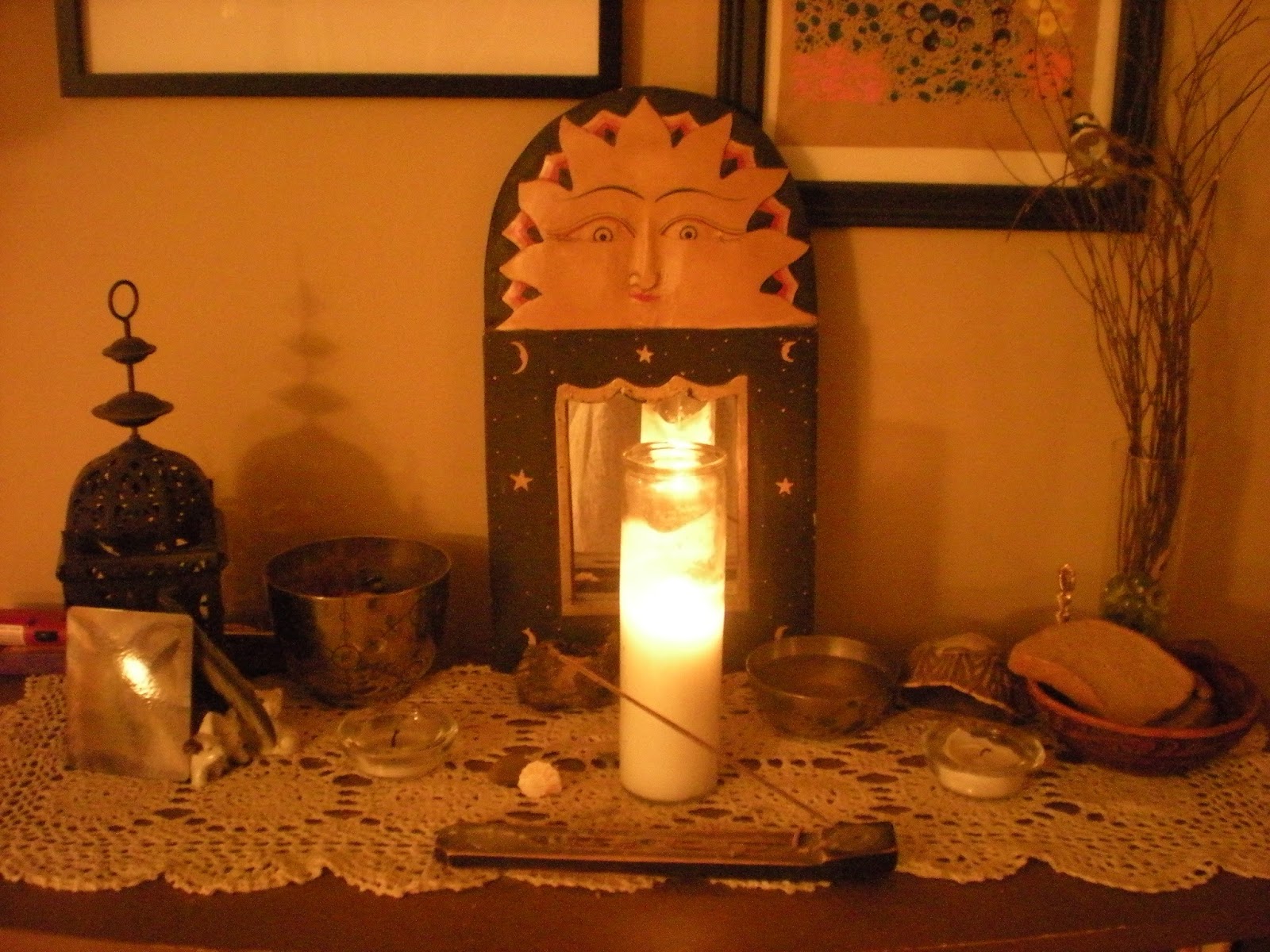
The silver bowl on the left is the main offering receptacle. Currently, there are several additional candles on the altar for special prayers. Members of the household will sometimes put nature artifacts on the altar; in this picture one might be able to spy a few feathers, a turtle shell and a piece of drift wood. My older daughter has placed a small cat figurine on the altar (she has a special affinity for cats) and my younger daughter placed an omen card of a goat on the altar during a time when she was particularly interested in the god Piorun. The wooden bowl to the far right currently serves as an offering bowl for the household domovoi. This bowl receives regular gifts of bread and salt, especially when something goes missing.
My future plans for this altar include a new altar cloth which I have been embroidering over the past several weeks as an act of devotion for Mokosh. I have never been very satisfied with our tree representation and continue to search for alternatives. Eventually, a place for the domovoi offering will be made next to the stove, as this is a more traditional location.
I also have a very small personal altar on the wall next to my bed (pictured below). I have had this altar for about six months and have always kept it very simple and intimate. I have also set aside place on our property for a future altar with special attendance to the nature spirits.

Virtues Essay: Piety
PIETY: noun
the quality of being religious or reverent
--Oxford American English Dictionary
Piety is a word that seems to have lost favor with the modern mainstream crowd. Once spoken of with reverence, piety now brings to mind (at least among my non-pagan peers), images of lampoonish religious devotion, including but not limited to hooded monks rhythmically pounding their foreheads with some anointed tome.
In real, everyday life, piety rarely looks similar to such flamboyant and stereotypical visions. Among pagans, true and sincere piety might be observed in the simple act of faithfully filling the bird feeder, or in taking a precious few minutes each day to pray to the Kindreds, or even in reviewing the daily obituaries and sending sympathy cards to surviving loved ones. To be sure, there are some grand gestures which absolutely fall within the realm of piety. For example, taking an oath before one's gods or constructing a personal or public nemeton. What all these acts, both great and small, have in common at their core is respect: respect for the gods, respect for our nature kin, and respect for the ancestors. Through the doing of these deeds intended to honor this respect, in these acts of piety, we manifest into this world a living and breathing *ghosti.
It is these acts of piety which serve as our common covenant, a covenant of mutual hospitality, with the Kindred.
“Piety is a discipline of the will through respect. It admits the right to exist of things larger than the ego, of things different from the ego.” --Richard M. Weaver
the quality of being religious or reverent
--Oxford American English Dictionary
Piety is a word that seems to have lost favor with the modern mainstream crowd. Once spoken of with reverence, piety now brings to mind (at least among my non-pagan peers), images of lampoonish religious devotion, including but not limited to hooded monks rhythmically pounding their foreheads with some anointed tome.
In real, everyday life, piety rarely looks similar to such flamboyant and stereotypical visions. Among pagans, true and sincere piety might be observed in the simple act of faithfully filling the bird feeder, or in taking a precious few minutes each day to pray to the Kindreds, or even in reviewing the daily obituaries and sending sympathy cards to surviving loved ones. To be sure, there are some grand gestures which absolutely fall within the realm of piety. For example, taking an oath before one's gods or constructing a personal or public nemeton. What all these acts, both great and small, have in common at their core is respect: respect for the gods, respect for our nature kin, and respect for the ancestors. Through the doing of these deeds intended to honor this respect, in these acts of piety, we manifest into this world a living and breathing *ghosti.
It is these acts of piety which serve as our common covenant, a covenant of mutual hospitality, with the Kindred.
“Piety is a discipline of the will through respect. It admits the right to exist of things larger than the ego, of things different from the ego.” --Richard M. Weaver
Wednesday, September 11, 2013
Virtues Essay: Wisdom
WISDOM: noun
The quality of having experience, knowledge, and good judgment; the quality of being wise.
The quality of having experience, knowledge, and good judgment; the quality of being wise.
--Oxford American English Dictionary
Wisdom is one of those deceptively weighty words that gets used in the common vernacular with little acknowledgement of the depth that the word truly entails. Often used in place of "intelligence" or "knowledge", wisdom carries with it much more than a simple gleaming of some book-bound subject. This is not a word that belies only a superficial capture of information. Although it is a noun, the definition of wisdom, in my opinion, inherently contains the imprint of actions - a back story that ripples with the echos of verbs.
Behind the knowledge that wisdom suggests is a story of effort, of work. With sleeves rolled up, a person who has wisdom has done what was necessary to bring static, printed words to life. She has learned the principles, has applied them to life and, like an artist, sculpted and molded those experiences into something more: wisdom. A fisherman will not have wisdom until he casts a line into the water, again and again. One may read a book about how to grow vegetables, but it is the avid gardener - with stained knees, gritty hands and sunburnt neck - that has the wisdom of gardening.
Within the pagan community, wisdom comes from years of learning and years of living; learning about hearth cultures, high days and traditions and living each day (with all the challenges and celebrations of life) while keeping the Kindreds and our virtues relevant and at hand. What is it like to live life out loud as a pagan? To keep vigil at your altar throughout the year? What does it mean to represent your grove in the greater community? These are types of questions answered through wisdom.
"By three methods we may learn wisdom: first, by reflection, which is noblest;
second, by imitation, which is easiest; and third by experience, which is the
bitterest." --Confucius
Tuesday, August 6, 2013
Slavic Third Cross-Quarter Ritual
This is the text I wrote for a Slavic third cross-quarter ritual. It was performed by our local Grove on August 2, 2013. Pronunciation guides are provided for those not familiar with the Polish language.
<3 chimes each for the Ancestors, the Spirits of the Land, and The Shining Ones>
Initiating the Rite: We have come here to honor the Gods and Goddesses. Be with us, oh Shining Ones, in our workings; forgive any errors and grant us, we pray, your blessings.
Purification: <use sage> By the might of the smoke of the fire, this gathering is made whole and holy.
Honoring the Earth Mother: Matka Ziemia (MAT-ka ZHAY-meeya) - we are your children, born of your womb and nourished by your abundance. You are the foundation of each day, as we place our feet upon you and walk this world. We pray that you bless and uphold our rite today, as you uphold the whole world. Matka Ziemia (MAT-ka ZHAY-meeya)- accept our sacrifice! (offer cornmeal, all repeat: Matka Ziemia (MAT-ka ZHAY-meeya), accept our sacrifice!)
Statement of Purpose: We have come today to do as the ancients did - to make offerings to the kindreds in gratitiude and to ask for their blessings as we begin the first harvest.
Recreating the Cosmos:
Deep water of the well - your living water saturates down into the ground, nourishing tender roots and seeds even while they slumber. And you flow beyond, past soil and stone into a land of memory and shadow, the land of our ancestors. Without you our world would be barren and lonely. Please accept this gift of silver as receipt of our gratitude for all which you provide to us. (put silver in the well)
Fire burning brightly - you are a force all your own. You manifest from stone and wood, producing from within the gifts of Dazhbog (DAZH-bogh), the celestial smith and Piorun (pee-YO-run) , wielder of lightning. You, above all others, have the ability to transform our offerings into that which is acceptable to the Shining Ones. We thank you for the transformation of our sacrifices and offer you this oil in gratitude. (pour oil into the fire)
Mighty tree - you which weaves all worlds together. Your branches stretch and reach towards The Shining Gods and Goddesses, your roots meander deep into the soft earth beckoning to the ancestors, and your trunk connects all here, with us, in our world today among ourselves and the spirits of this land. We offer you this incense in deep appreciation of your services both in the past and that which you will provide here today. (light incense and place in front of tree)
Opening the Gate: Weles (VAY-les) - punisher of broken oaths, mighty god of liminality and master of the gates between the living and the dead: we ask that you tend this gate here today, so that the Kindreds may join us in this holy space while the outdwellers keep their distance. Weles (VAY-les), we honor you and this most important task you perform and offer you this sacrifice in deepest appreciation. (pour whiskey on the ground, all repeat: Weles (VAY-les), accept our sacrifice!)
Let the gates be open. The water, the fire and the tree flow and flame and grow within us. Feel your roots burrow deep, draw up the water of life, and stretch your branches towards the fire of the sky.
Offerings to the Kindreds:
Ancestors, those who offered the first sacrifice and learned the proper ways to honor the Gods and Goddesses - you are welcome here at our fire! We greet you with joyous hearts and kind words. Join us here as we honor the Shining Ones in the ways you have taught us, and partake of this offering. Ancestors, accept our sacrifice! (offer mulberry wine, all repeat: Ancestors, accept our sacrifice!)
Spirits of this land, you who live among the trees, in the tall grasses and deep withing the native waters, you have a place here at our fire. You who know the inborn rhythms of Matka Ziemia (MAT-ka ZHAY-meeya), who see the rising and setting of the sun each day and whisper to the wild animals, you have a place here at our fire. We give you honor and welcome you with this gift. Nature Spirits, accept our sacrifice! (offer salt, all repeat: Nature Spirits, accept our sacrifice!)
Shining Ones, Gods and Goddesses worthy of worship, you who make all things possible - join us here at this fire. Your glory is brighter than all creation and inspires greatness in those who follow you - join us in this blessing of the harvest as we begin to reap from the fields and gardens that which will nourish us and our loved ones. We offer this sacrifice as ourt hearts call for you. Shining Ones, accept our sacrifice! (pour mead, all repeat: Shining ones, accept our sacrifice!)
Dieties of the Rite:
Mighty Piorun (pee-YO-run) - god of lightning, dispenser of justice. You who triumphs over chaos and brings order to this world. Come to our fire! With your mighty powers you conquer the serpent which threatens to destroy our world in confusion and drought. You control the rains, and as such decide which lands are blessed. It is your shield that plows the fields and heralds the planting season, and the sharp edge of your axe aids the harvest. We offer you this gift of mead in gratitude for watching over the fields these many months. Piorun (pee-YO-run), accept our sacrifice! (pour the mead into the fire, all repeat: Piorun (pee-YO-run), accept our sacrifice!)
Svarog (SVA-roog) - god of the heavenly fire and father of Dazhbog (DAZH-bogh), you have warmed the earth so life could blossom and grow. Come to our fire! Yours is a delicate balance, a careful dispensing of the sun's rays. In your wisdom you moderated your awesome power so as to not damage the young plants in the field. Thank you for providing this most important force so that the plants in our gardens could grow and become part of the feast at our tables. We offer you this gift of whiskey in gratitiude. Svarog (SVA-roog), accept this sacrifice! (pour whiskey into the fire, all repeat: Svarog (SVA-roog), accept our sacrifice!)
Mokosz (MO-kosh) - goddess of grain and seed, you who germinates and gestates the seeds, roots and shoots that brings life to our world. Come to our fire! Your gifts are abundant and provide nourishment and enjoyment both for our bodies and our souls. We thank you for nurturing the seeds and tender plants we placed into the warming ground this growing season, and offer you this gift of vegetables in return. Mokosz (MO-kosh), accept our sacrifice! (place the vegetables in the fire, all repeat: Mokosz (MO-kosh), accept our sacrifice!)
Personal Offerings
Omens: We ask that the Kindreds speak to us, and offer us their teachings. <go through each kindred with the omens, then affirm the omens)>
Hallowing of the Waters: As children of the Earth we call for the blessings of the Kindreds. We fill the bellies of our spirit with this drink - oh Holy Ones, give to us as we have given to you! Let this vessel receive your blessings! (each person drinks water)
Affirmation of the Blessings: By this work we are blessed. To all that have aided us here today, we give thanks.
Thanking the Beings:
Mokosz (MO-kosh) - Beholder of creation - may we always be right in our worship of you and the recipient of your blessings.
Svarog (SVA-roog) - Champion of the sun and dispenser of it's life force, thank you the blessing of this warmth.
Piorun (pee-YO-run) - Mighty warrior! We give our gratitude for your blessings here today.
Closing the Gates: Weles (VAY-les), we offer you thanks for minding the gates so that we could honor the Kindreds here today in peace.
Thanking the Earth Mother: Matka Ziemia (MAT-ka ZHAY-meeya), thank you for upholding this rite and blessing us daily with your generous gifts.
Statement of Ending: With this our ritual is complete. May the tree be just a tree, the well just water, and the fire but a simple fire. Let us leave here today with blessings upon us and peace within us.
Subscribe to:
Posts (Atom)